Raj Kapoor – The Musician
____________________
Back to Legends – Raj Kapoor
____________________
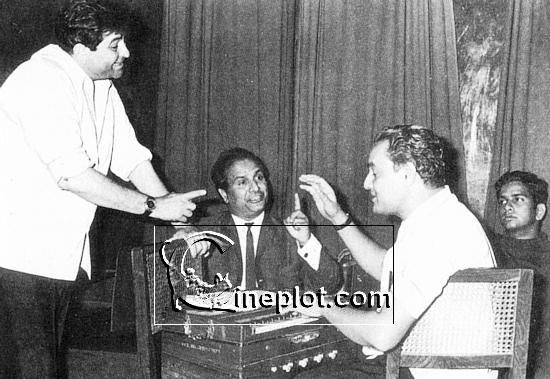
Raj Kapoor with Shankar and Mukesh in 1968
Despite his permanent musical team comprising Shankar-Jaikishan, lyricists Shailendra and Hasrat Jaipuri and singer Mukesh, it was Raj Kapoor himself whose stamp pervades all his music. He had a great ear for music, an innate sense of rhythm and could play most musical instruments by ear. His favourites were the dholak and the tabla. His favorite ragas were Bhairavi, Shivranjani, Pahari, Malkauns and Darbari.
Raj Kapoor’s song sittings were famous. He loved to listen to tunes, to prune and trim the compositions, to correct the singers. While his lyricists wrote, he fine tuned the lyrics, and while the composers composed, he perfected the compositions to suit his taste.
Till date, the music of all his films remains immensely popular and has Raj Kapoor’s signature indelibly on it. One just hears a bar of his music and can identify it as a composition from RK Films. Lata Mangeshkar reiterated this at a function to celebrate Ram Teri Ganga Maili. She said, “The music of RK Films may have been attributed to Shankar-Jaikishan, then Laxmikant-Pyarelal and then Ravindra Jain. But I, as the singer who has sung for his productions from Barsaat onwards, can vouch for the fact that all of RK music is in the ultimate analysis Raj Kapoor’s own creation.”
He admitted, “From the earliest days, I have been interested in music. In fact, my first ambition was to be a music director. I even sang in my earlier films like Chitchor, Chitor Vijay, Jail Yatra and Gopinath. When words fail, it is music that conveys much more than all words put together.” And he more than executed this in his song picturisations.
In his films, the songs stand out not as mere reliefs from the narrative or as intrusions, but are important cogs which move the story forward. Like his peers Bimal Roy and Guru Dutt, he gave as much importance to the execution of a song as to a scene.
The songs were often important expressions of emotions which could not be conveyed through dialogues.
Raj Kapoor’s songs could even be considered the real triggers of social change, even more than the films themselves. The lyrics had real substance. For him, the songs were truly not only audio but audio-visual. He saw music as it were; and only when he could how the song could be filmed, did he okay its recording. His use of elaborate sets, of light and shade to convey sombreness and technicolour to project joy, were all part of his visual perception. He was so closely associated with his music that in Jagte Raho, when the song ‘Zindagi khwab hai’ was picturised on Motilal rather than on Raj himself, the public was bewildered.
The songs were always recorded first and it is said that his tunes were composed even before the lyrics were written. But there were interesting exceptions like Boot Polish and Jis Desh Mein Ganga Behti Hai. Initially, there were going to be no songs in Boot Polish, directed by Prakash Arora under the RK banner (though the Raj Kapoor touch is blatantly evident in the film). But after viewing the film, Raj Kapoor decided it needed songs. And for the first time in his production, songs were written, composed and situations created for them after the whole film was complete! So exquisite are the songs of Boot Polish and so beautifully interwoven into the film that no one would guess that a ‘Chali kaun se desh gujariya to sajh dhajh ke’, or ‘John chacha tum kitne acche’, or ‘Nanhe munne bache teri muthi main kya hai’, were not part of the original script.
In Jis Desh Mein Ganga Behti Hai, Shankar did not want to compose at all, as dacoity was hardly the subject musicals were made of! So Raj Kapoor got the songs written first, and when Shankar realised the beauty of the lyrics, he composed the music. And these songs ultimately touched listeners where it hurt the most. They became almost anthems, to be sung at every independence day ceremony — numbers like ‘Aa ab laut chalen’ and ‘Jis desh main ganga behti hai’.
As a filmmaker, Raj Kapoor often took recourse to a song to introduce his character — a rather interesting and entertaining introduction device. For example, his ‘Mera joota hai Japani yeh patloon Inglistani… phir bhi dil hai Hindustani’ established the hero’s character in Shri 420. ‘Awara boon… ya gardish main boon aasman ka tara hoon’ establishes the identity of the tramp in Awara. This ploy allowed the song as much importance as an opening scene. The singularly hummable numbers were known to the audiences by heart and they watched his films again and again, adoring the lovable tramp happily dancing through the streets.
And, of course, Raj Kapoor’s musical genius found enough situations for utterly melodious romantic numbers like ‘Han maine pyar kiya, hai hai kya zulm kiya…, hum bhi hain, tum bhi ho’. He himself analysed, “My subject always suggested to me a particular kind of musical style unerringly — the style that would work out audio-visually right in the final unfolding of the film.”
It is said that even the lyrics of his songs were often sourced from his own life’s experiences. Once he and Nargis were travelling by train and they had a tiff. She got off the train and left. He turned to his companion saying “Khan saab, dekho na, chhod gaye balam, akela chhod gaye!” This was the germ of that classic number.
Again, during the making of Bobby he was talking on the phone with Simi Garewal, who was grooming the young Dimple for her film debut. At something she said he responded, “Tum jhoot bol rahi ho.” Simi, taken aback, replied, “I’m not lying, why should I?” But he insisted, “Nahin, tum jhooth bol rahi ho — tumhe kaala kauva kaate ga!” That was the genesis of ‘Jhooth bole kauva kaate….’!
Raj Kapoor greatly admired Lata Mangeshkar and his relationship with her remained turbulent, with the lady often taking umbrage when things did not go her way. But he always made it a point to make up with her. He just could not visualise his films without her singing.
Lata Mangeshkar’s tiff with him when she had to sing ‘Main ka karoon Ram mujhe buddha mil gaya’ in Sangam, has become legendary. She objected to the double meaning in the lyrics. But Raj Kapoor uncompromisingly insisted the song be sung as it is and by her alone. Though the lady was upset, the recording was done. Raj was not past cajoling, persuading and making everything subservient to the major goal of fulfilling his cinematic vision.
Later, in his biggest fiasco, Mera Naam Joker, it was Asha Bhonsle who sang for him, as in ‘Kahin daag na lag jaaye’. But when the film failed, it was partly attributed to Lata Mangeshkar’s absence from the film and when she reappeared in the RK produced Bobby, it’s success was also attributed to her presence – Lata Khubchandani
 ABOUT THIS AUTHOR
 Cineplot Music
 Cineplot Photo Gallery
 Lollywood - Future marriage plans and projects
 Bollywood - Year by Year - 1967
 Shakila in Aar Paar (1954)
 Mohammed Rafi (1924-80)
 Saif Ali Khan
Reply