Raj Kapoor – The Actor
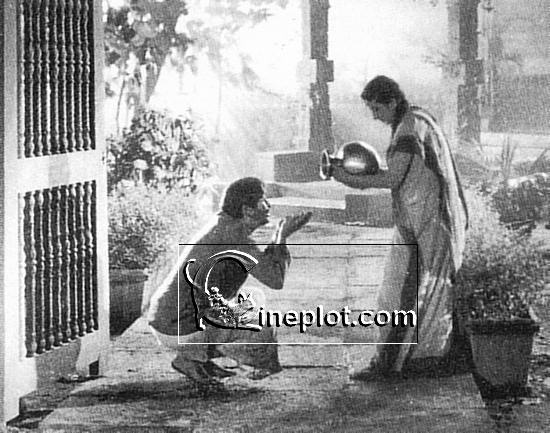
Nargis quenching Raj Kapoor's thirst in Jagte Raho (1956). Their last film together
Once Raj Kapoor was present at a performance by Topol (the actor in Fiddler on the Roof). When the play ended and the applause died down, Topol announced, “Ladies and gentlemen, there is a misconception that I am Israel’s most popular actor. That’s wrong. I am the second most popular man, the first being Raj Kapoor of India, who is present here with us today.” He then called Raj Kapoor to the stage to a standing ovation.
Everyone knew Raj Kapoor and this popularity, both at home and abroad, can be attributed to his ability to appeal both to the head and the heart at once. Raj Kapoor as an actor, had a fan following in India which could cause riots when he went out in public. The mobility of his face, the deep blue eyes which could portray both love and sadness with equal depth, the fine skin and the variety of expressions which crossed his face, made him adorable, the darling of the Indian masses. The audiences identified with him at an almost psychological level. He was at once the joker, the tramp, the clown and the romantic.
Only Raj Kapoor had the capacity to convey grief with a smile. In those days, the Indian audience was divided into two factions — the Dilip Kumar fans who loved his tragic intensity, and the Raj Kapoor loyalists who considered him the greater actor. “Can Dilip Kumar convey tragedy while smiling” they would ask unanswerably. Dilip was the larger-than-life tragedy king, while Raj modelled himself on the underdog, the street mongrel, the lovable homeless tramp who transformed the society around him through love.
Nanda remembers, “His face could express the tiniest of nuances with ease. If he was jealous, there would be a smirk on his face. If he was sad, his eyes reflected it immediately. I consider him the finest actor we have, along with Dilip Kumar.”
Raj Kapoor the director never intruded on Raj Kapoor the actor when he did outside films. His heroine Waheeda Rehman recalls, “When we were shooting for Ek Dil Sau Afsane and later for Teesri Kasam, I would often feel that some things were not right and must be changed. But he would merely say ‘I am not the director here, I’m only the actor and will do just as I am told!’ But even in those days, he was full of great ideas for his own films and talked about making Henna and Satyam Shivam Sundaram.”
“I,” says Nanda, “realised what a good actor he was when I played his wife in Aashiq. In one scene, I had to confront him and Padmini saying, ‘Whatever you are doing, do it in front of me!’ I was merely a teenager then, and very nervous about firing these two established seniors. But Raj Kapoor came up to me and said Nanda, yeh tumhara scene hai. I know you are going to do it well.’ And he insisted that director Hrishikesh Mukherji keep the camera on me. I realised how much confidence he had in himself as an actor to give up the scene to a co-star so completely” – Lata Khubchandani
 ABOUT THIS AUTHOR
 Cineplot Music
 Cineplot Photo Gallery
 The Story of an Imp called Tanuja
 Nigar Awards - 1967
 Shabnam - Nadeem
Reply