Talat Mahmood – Part 3
____________________
Profile – Part 1 – Part 2 – Part 3 – Part 4
Fact File – Filmography – Interview – Photo Gallery
Back to Legends – Talat Mahmood
____________________
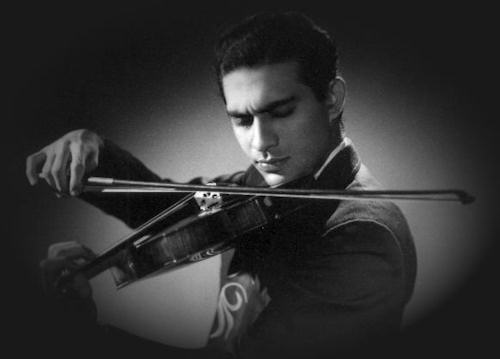
Talat Mahmood
The mood may be melancholic or mirthful – the mythic timbre remained intact over the decades. In 1980 HMV re-recorded some of Talat Mahmood’s vintage film songs in stereophonic sound. In the re-recorded compositions Talat Saab conveys the same sense of meditative profundity that he did three decades ago.
No wonder Jagjit Singh singles out Talat Mahmood for his mastery over the Ghazal. Whether in the film Ghazal like ‘Humse Aaya Na Gayaa’ in ‘Dekh Kabira Roya’ or giving a free rein to his aristocratic proclivities in a non film ghazal like ‘Kaun kehta hai tujhe’, fans loved the velvety vibrations of Talat Saab’s vocals. The trademark tremor transported the traditional Urdu ghazal gayaki to a plane of splendid sensuality. Penetrating and knowledgeable, Talat Mahmood’s rendition was never tinged or corrupted by those telltale tones of the arrogance that creeps into some of the world’s most accomplished performers who cannot help flaunting their accomplishments in their performing style. Talat Mahmood’s singing style was never exhibitionistic. He forever believed in shaded and underplayed singing – a style that conferred an infinite but hushed majesty on both his solos and duets.
According to a rough estimate Talat Mahmood sang 700 songs in 13 Indian languages including Bengali, Gujrati, Marathi, Bhojpuri and Sindhi. Though his singing sensibilities were suffused in a Lucknow courtliness, Talat Mahmood’s gayaki belonged to every Indian who had ever heard and swooned to his sensuous voice, Fans in India and abroad thronged to watch this ‘Ghazal ka Sartaj’ perform live on stage.
Talat Saab was in fact the first singer from Mumbai to perform outside India. In 1961 he visited Pakistan to sing before a 60,000 strong audience of near-hysterical men and women who were ecstatic to have their favorite Indian ghazal singer in their midst.
An eyewitness still goes misty-eyed as she remembers Talat Mahmood regaling his fans across the border with his satin-soft and wondrous renderings of ‘Aa teri tasveer banaa loon’ (Nadaan), ‘Main dil hoon’ (Anhonee), ‘Woh zalim pyar kya jaane’ (Parchhain) and ‘Chal diya karvan’ (Laila Majnu).
“Before we heard Talat Miyan we thought Begum Akhtar was the ultimate Ghazal singer from India” enthuses a Pakistani fan who had the privilege of hearing Talat Mahmood perform live. “But after we heard him we knew Allah had graced another singer with a voice that could penetrate deep into the recesses of a Ghazal, fathom what’s most desirable and durable in it, and convey it to an audience as an externalized truth without seeming aware of the presence of an audience”.
Fans recall Talat Saab’s complete understanding of the poetry of a Ghazal far and wide to countries which became his adopted singing territory.
In 1968 he went to Trinidad in the West Indies where he was accorded a royal welcome. Hundreds of flag waving members of the ‘Talat Mahmood Fan Club’ lined both sides of the highway leading from the International Airport in the suburbs of the islands, to the capital city of Port of Spain. As Talat Mahmood drove through the sea of humanity his face lit up with a thousand unexpressed thoughts of joy and gratitude.
As the decade passed by, Talat Saab was to encounter the love, adulation and hysteria of fans all over the world. In 1979 he performed at the Royal Albert Hall (the second singer from Mumbai after Lata Mangeshkar to perform at this prestigious venue). In 1984 Talat Saab thrilled thousands of fans of every nationality and creed at the Al Nasar Leisure in Dubai.
Communal or religious considerations have never stood in the way of Talat Mahmood’s abiding bond with his admirers. Both Hindus and Muslims alike have been overwhelmed at one time or another by Talat’s film and non-film Ghazals, by his mind-blowing mastery over the nuances of the Urdu language and his ability to project those nuances in a style that’s accessible and listener-friendly.
While Talat Saab sings, ‘Mohabbat hi na jo samjhe woh zaalim pyar kya jaane’ in Parchhain he makes Noor Lucknavi’s poetry accessible to every listener out there who has ever wondered what love meant in a cold heartless world. The meaning of the key word ‘Zaalim’ in the above song was intuitively communicated in the manner in which the word is put across.
 ABOUT THIS AUTHOR
 Cineplot Cinema & Films
 Cineplot Photo Gallery
 Legends – Suraiya
 Bashir Ahmed
 Talat Mahmood's Song List (1945 - 1950)
 Shamshad Begum's Song List (1951 - 1955)
 Kishore Kumar's Song List (1961 - 1965)
(add)- 2 Comments
- Trackbacks/Pingbacks