Hemant Kumar – Part 2
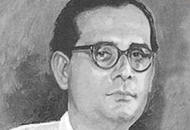
Hemant Kumar
“Which rival musician would provide that kind of encouragement to a then unknown musician like me?” Bhupen Hazarika shakes his head in wonderment. Hailing a taxi Hemantda took the stupefied young Bhupen Hazarika to the HMV office in Calcutta and a deal was finalized on the spot. Later in Mumbai Hemant Kumar, already a reputed singer-composer, introduced Bhupen Hazarika to Lata Mangeshkar and a host of eminent musical luminaries telling them about this talented young musician named Bhupen Hazarika.
Bhupen Hazarika isn’t isolated in his appreciation of Hemant Kumar’s generosity. Other musicians, fellow composers and singers recall how he went out of his way to encourage them and accommodate them into his compositions as well as into those of his colleagues.
Sandhya Mukherjee who became famous in Calcutta as the voice of Suchitra Sen was brought to Mumbai to sing the frolicsome duet Aa gupchup gupchup pyar karen under the baton of Sachin Dev Burman, reportedly on the recommendation of Hemantda.
In a world where self-interest not only takes precedence, but also limits the human vision, Hemant Kumar always went out of his way to help his colleagues from the music world. To him the rites and processes of music creation weren’t isolated. He saw himself as just one unit in the creative universe– a brick in the creative wall.
This accounts for the illimitable reserves of abiding sweetness in the creative faculties of God’s chosen one – Hemant Kumar.
Hemant Kumar was also a very talented composer. Lata Mangeshkar (who sang Hemantda’s most cherished tunes into the hall of fame) reminds us of Hemant Kumar’s proficiency. “Hemantda believed in simple tunes. He didn’t subscribe to elaborate orchestras. Since he was a singer himself he could explain his requirements in their exactitude”.
The results are to be heard to be believed. From the sinuous Man dole Lataji moves magnificently into another province of Hemantda’s melodiousness with Chhup gaya koi re. Kahin deep jale kahin dil composed by Hemantda for his own production Bees Saal Baad, was a very very special song for Lataji. Prior to this song the Nightingale had fallen ill. Doctors expressed serious doubts whether she would be able to sing again. Lataji pointedly chose to return to the recording room with Kahin deep jale kahin dil. If a Hemant Kumar composition couldn’t prove her vocal supremacy all over again, nothing else could.
Lataji made a stupendous comeback with Kahin deep jale kahin dil even winning the Filmfare award for best playback singer for this intricately woven jewel of a haunting melody. Two years later Hemantda gave his favorite singer two other melodious treats in his next home production Kohraa. Between O beqaraar dil and Jhoom jhoom dhalti raat. How does one choose the better melody?
Hemant Kumar never composed anything but the best melodies. Compromise was alien to him. Whether he composed a flirtatious Saara mora kajra churaya tune or a sublime Kuch dil ne kaha it was always his dil which spoke up on Hemantda’s behalf in the language of the lilt.
The piece de resistance of Hemantda’s career as a composer in Mumbai was Sahib Bibi Aur Ghulam. For the one opportunity that Hemantda got to compose for Guru Dutt’s cinema (which was dominated by the music of S.D.Burman and O.P. Nayyar) Hemantda pulled out all stops for a score that ranks as one of the ten best ever composed for Hindi cinema.
Between them Geeta Dutt and Asha Bhosle created a universe of pain and romance in Sahib Bibi Aur Ghulam. From Geeta Dutt’s Na jaao saiyyan to Asha Bhosle’s Bhanwara badaa nadaan, each number numbs, each songs stuns each note cuts deeply in Sahib Bibi Aur Ghulam. In a repertoire cluttered with monumental melodies Hemant Kumar’s Sahib Bibi Aur Ghulam ranks as the best score in Guru Dutt’s cinema.
Quality work was the hallmark of Hemantda’s oeuvre. At least three of his scores in the 60s qualify among the greatest of the decade. These are Sahib Bibi Aur Ghulam,
Anupama and Kohraa. If we sample Na jaao saiyyan, Bhanwara badaa nadaan, Kuch dil ne kaha, O beqaraar dil and Jhoom jhoom dhalti raat from the three monumental scores of Hemant Kumar in the 60s we are left wondering about this tunesmith’s tireless tenacity and his power to harness melodies into widely acceptable shapes and sizes.
 ABOUT THIS AUTHOR
 Cineplot Cinema & Films
 Cineplot Photo Gallery
 Josh S.I.N.G(s) for Pakistan’s flood victims
 Hemant Kumar - Part 3
 Shaking a leg - Rahat Fateh Ali Khan
 Music as a sign of the times
 G.M. Durrani – Interview
Reply